



 Add Galorath as a preferred source on Google
Project management is the foundation that transforms business goals into structured plans and successful outcomes. It encompasses the methods, tools, and strategies used to lead a project from initial concept to final delivery while balancing time, cost, scope, and quality.
Project management is a task management discipline that drives results across industries by combining strategy, structure, and coordination. At its core, it enables organizations to turn ideas into outcomes through clearly defined phases-initiation, planning, execution, monitoring, and closure.
This guide introduces the key components of modern project management, including who uses it, why it matters, and how different methodologies such as Waterfall, Agile, Scrum, Kanban, and Lean support different types of work.
Common tools like Gantt charts, Kanban boards, and task trackers are essential for keeping projects on schedule and teams aligned. Core functions such as cost estimation, labor planning, schedule tracking, and risk management are explained alongside metrics like Earned Value Management that measure performance and quality. The guide also highlights the strategic role of project managers in aligning resources, coordinating stakeholders, and optimizing portfolios.
What exactly means to manage a project?
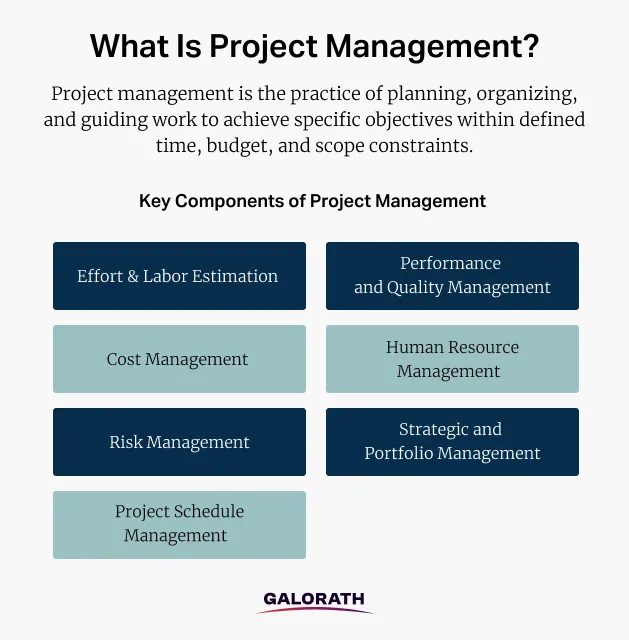
Project management is the practice of planning, organizing, and guiding work to achieve specific objectives within defined time, budget, and scope constraints. As defined by the Project Management Institute, “Project management is the application of knowledge, skills, tools, and techniques to project activities to meet the project requirements.”. It provides a structured framework for turning ideas into actionable plans and ensures that each phase of a project moves forward with clear accountability and purpose.
A project is defined as a temporary effort undertaken to create a unique product, service, or result, and project management ensures this effort is completed efficiently and successfully. As Greg Cimmarrusti, PMP, explains, “Project management is about breaking down overwhelming objectives into manageable tasks, assigning accountability, and keeping people focused on results.”.
The discipline of project management includes five primary phases: initiation, planning, execution, monitoring and controlling, and closure. These phases help guide teams through complex tasks while managing expectations and resources. Each phase builds on the previous one to move the project toward completion.
Project managers apply industry-recognized methodologies to their projects depending on the nature of the work and organizational goals. Their responsibilities include setting timelines, managing and tracking budgets, mitigating risks, communicating with stakeholders, and ensuring deliverables meet quality standards.
By using project management software tools such as Jira, Asana, or Microsoft Project, teams collaborate more effectively, track key milestones, and maintain transparency throughout the project lifecycle. Teams stay aligned and avoid confusion by using these project management tools.
Project Management turns abstract goals into measurable outcomes and aligns people and processes with clear direction. Or as Dr. Harold Kerzner puts it, “Project management is the art of creating the illusion that any outcome is the result of a series of predetermined, deliberate acts when, in fact, it was dumb luck.” While tongue-in-cheek, it reflects the essential role of structure in bringing order to chaos.
Why Is Project Management Important to Business Success?
The importance of project management in business lies in its ability to deliver results through structure, clarity, and accountability. Without a clear framework, businesses risk missed deadlines, budget overruns, and misaligned priorities.
Project management ensures that goals are broken into actionable steps, resources are allocated efficiently, and teams stay focused on delivering value. From product launches to internal process improvements, every business initiative benefits from having a defined plan and a dedicated leader.
Project management enables organizations to operate with greater predictability and control. By setting clear milestones and assigning responsibilities, it reduces confusion and improves team collaboration. This coordination helps prevent scope creep, minimizes delays, and ensures stakeholders are informed at every stage. Effective project management practices improve visibility, encourage accountability, and help teams adapt to change with greater resilience.
Businesses also use project management to align strategic goals with operational tasks. A project manager acts as the link between high-level objectives and day-to-day execution. This ensures that business priorities are reflected in the work being done and that resources are used where they can create the greatest impact. A well-managed project is more likely to meet customer expectations, stay within budget, and support long-term growth.
Risk mitigation is another key reason why project management is vital in business. Through careful planning, risk identification, and proactive decision-making, project managers help organizations anticipate challenges before they become problems. This foresight allows teams to build contingency plans and reduce potential disruptions.
Project management also provides measurable insights. With structured reporting and performance tracking, businesses can evaluate project outcomes, understand what worked, and apply those learnings to future efforts. These insights support continuous improvement and better decision-making over time.
Who uses project management?
Project management is used by professionals across industries to plan, organize, and deliver work more effectively. Project management is essential in every field where goals need to be achieved within defined constraints like time, cost, and scope. From marketing and HR to finance and education, teams across departments use project management practices to coordinate tasks, track progress, and meet objectives.
In technology companies, project management is used by software developers, product managers, and IT teams to organize releases, fix bugs, and deliver digital solutions. Agile methodologies like Scrum and Kanban are common in these settings, offering frameworks that help teams iterate quickly and prioritize effectively.
In construction and engineering, project management helps coordinate timelines, materials, and personnel across large, complex builds. Project managers in these fields rely on tools like Gantt charts, critical path analysis, and procurement planning to ensure projects are delivered safely, on budget, and to specification.
Marketing teams use project management to launch campaigns, produce content, and manage creative workflows. By using project management tools, marketers can streamline communication, stay on top of deadlines, and align with business objectives. Marketing project management helps teams deliver quality campaigns while staying adaptable to client or market changes.
Human resources departments apply project management when organizing training programs, onboarding processes, and employee engagement initiatives. These internal projects benefit from structured planning and resource allocation, ensuring that important initiatives are executed consistently and tracked for impact.
Healthcare organizations use project management to improve patient services, implement electronic health records, and manage compliance with regulatory requirements. These projects often require coordination among multiple stakeholders, including doctors, IT specialists, and administrative staff.
Even nonprofit organizations and educational institutions use project management to coordinate grants, manage outreach programs, or implement learning technologies. Project management gives teams of all sizes the structure to operate more efficiently and demonstrate accountability to donors, boards, or public stakeholders.
Executives and team leaders rely on project management to align strategy with execution. Whether launching a new product, expanding into new markets, or undergoing digital transformation, project management ensures that business goals are translated into clear, actionable steps.
Project management is not limited to any one job title or industry. It is a universal discipline that empowers individuals and teams to stay organized, deliver results, and adapt to change. By promoting clarity, structure, and accountability, project management helps professionals in every sector succeed.
What are Project Management Methodologies?
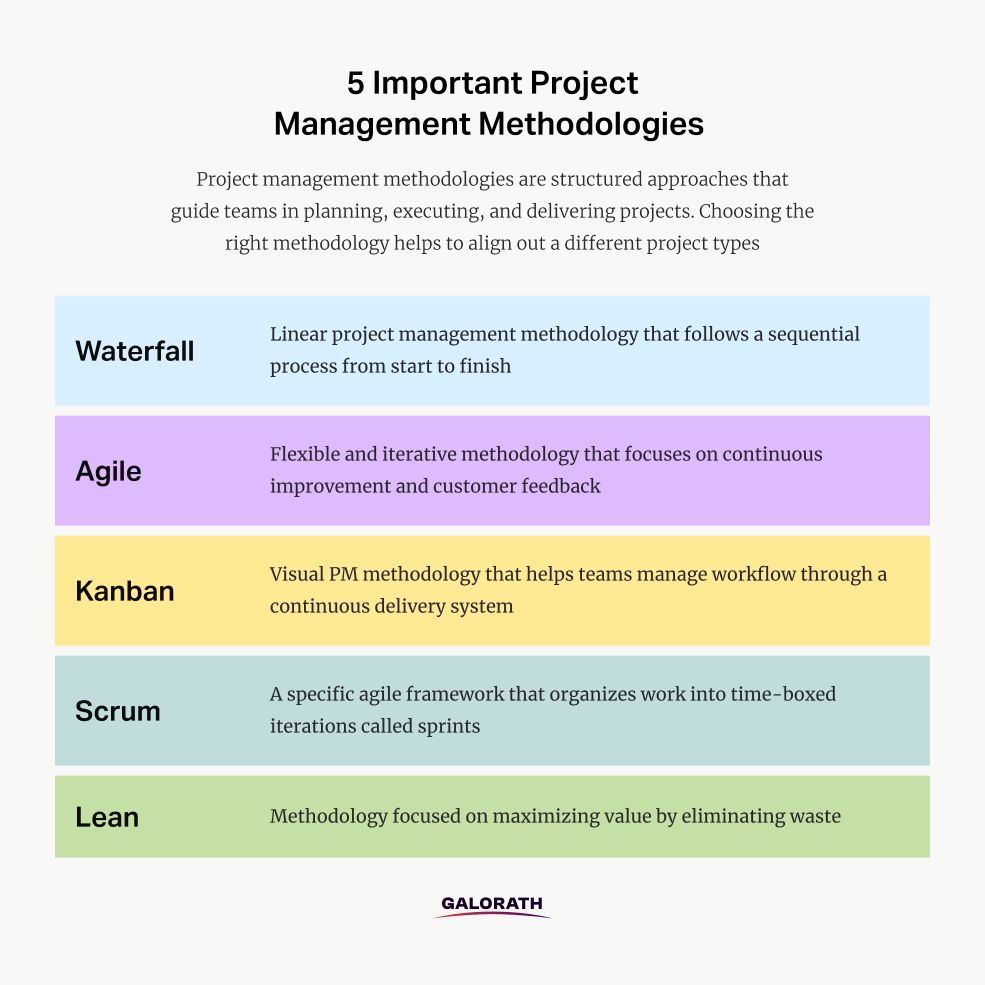
Project management methodologies are structured approaches that guide teams in planning, executing, and delivering projects. Choosing the right methodology helps teams align processes, manage resources, and adapt to different project types or industries. Whether working on a prototype development, software development cycle, or internal process overhaul, the methodology you choose can directly impact efficiency and outcomes.
5 Important Project Management Methodologies
Below are five of the most widely used project management methodologies. Each offers a different way to approach work and is suited to specific project environments, team dynamics, and business goals.
Waterfall
Waterfall is a linear project management methodology that follows a sequential process from start to finish. In Waterfall, each phase of the project-such as planning, design, development, testing, and deployment-is completed before the next begins. There is little flexibility to revisit earlier phases once a stage is completed. This methodology works best for projects with clearly defined requirements and minimal changes, such as construction or infrastructure development.
Because of its rigid structure, Waterfall is ideal when compliance, predictability, and detailed documentation are critical. However, it can be less effective for projects that need to pivot or evolve during execution.
Agile
Agile is a flexible and iterative project management methodology that focuses on continuous improvement and customer feedback. Agile projects are broken into smaller cycles called iterations or sprints, with regular opportunities to assess progress and make adjustments. This methodology is commonly used in software development, but its adaptive nature has made it popular in marketing, product design, and cross-functional team environments.
Agile encourages collaboration between stakeholders and teams. Its principles are outlined in the Agile Manifesto, which emphasizes individuals and interactions, working solutions, customer collaboration, and responsiveness to change. Agile helps teams move quickly while minimizing risk by delivering incremental value throughout the project lifecycle.
Scrum
Scrum methodology is a specific Agile framework that organizes work into time-boxed iterations called sprints. A Scrum team typically includes a product owner, a Scrum master, and developers or contributors who meet daily in stand-up meetings to discuss progress and blockers. At the end of each sprint-usually lasting two to four weeks-the team delivers a potentially shippable product increment.
Scrum supports transparency, inspection, and adaptation. It is particularly effective for complex projects where customer needs may evolve. Teams using Scrum rely on backlog grooming, sprint planning, sprint reviews, and retrospectives to ensure that work remains focused and aligned with goals.
Kanban
Kanban is a visual project management methodology that helps teams manage workflow through a continuous delivery system. Work items are represented on a Kanban board with columns such as “To Do,” “In Progress,” and “Done.” This allows teams to see the status of tasks in real time, identify bottlenecks, and optimize flow.
Kanban is highly flexible and works well in environments where work arrives unpredictably or where priorities shift frequently. Unlike Scrum, there are no time-boxed sprints, making Kanban ideal for teams that focus on continuous delivery and incremental improvement. Its emphasis on limiting work in progress (WIP) ensures that teams do not become overloaded and can maintain a steady pace.
Lean
Lean project management is a methodology focused on maximizing value by eliminating waste. Lean principles were originally developed in manufacturing, particularly in the Toyota Production System, but have since been adapted to other industries such as software, healthcare, and logistics. The core idea is to deliver more value to customers using fewer resources.
Lean emphasizes continuous improvement, respect for people, and efficient workflows. Tools like value stream mapping, root cause analysis, and the 5S system help teams identify inefficiencies and streamline processes. By reducing waste and improving flow, Lean enables teams to increase speed, quality, and customer satisfaction.
What are the Most Frequently Used Tools in Project Management?
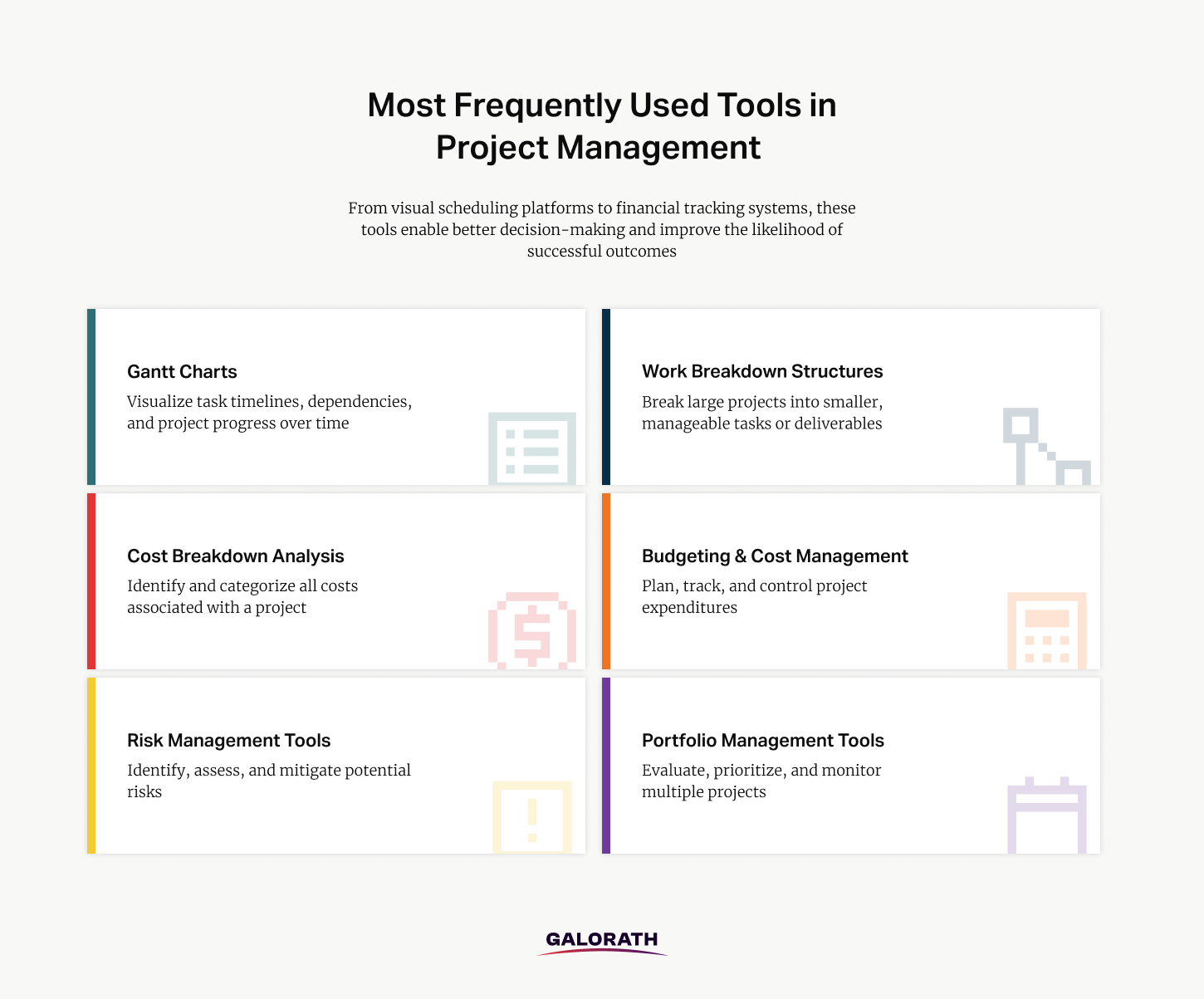
The most frequently used tools in project management are the ones which help teams plan, track, budget, and assess projects more efficiently across all phases. Project managers rely on specific tools to streamline workflows, monitor performance, and reduce risks. From visual scheduling platforms to financial tracking systems, these tools enable better decision-making and improve the likelihood of successful outcomes. Below is a list of the most frequently used project management tools and their core functions.
Gantt charts are frequently used in project management to visualize task timelines, dependencies, and project progress over time. Gantt charts make it easy for teams to understand the project schedule, identify delays, and coordinate deadlines by mapping out tasks along a horizontal time axis.
Work breakdown structures (WBS) are used to break large projects into smaller, manageable tasks or deliverables. A WBS provides a hierarchical view of the project scope, helping teams organize responsibilities, track progress, and ensure that all components of the work are accounted for.
Cost breakdown analysis is used to identify and categorize all costs associated with a project. By dividing expenses into detailed categories, cost breakdown analysis helps project managers create accurate budgets, monitor spending, and identify cost-saving opportunities.
Budgeting and cost management tools are used to plan, track, and control project expenditures. These tools help ensure that the project stays within financial limits by forecasting costs, comparing actuals to budgets, and adjusting allocations as needed.
Risk management tools are used to identify, assess, and mitigate potential risks that could affect project success. These tools enable teams to create risk registers, assign risk owners, and develop contingency plans to reduce the impact of unexpected events.
Portfolio management tools are used to evaluate, prioritize, and monitor multiple projects across an organization. These tools allow leaders to align projects with strategic goals, allocate resources effectively, and track overall performance at a portfolio level.
Project Lifecycle & Phases
The project lifecycle and phases provide a structured framework for managing projects from start to finish. Each phase builds on the one before it, helping teams move from ideas to outcomes in a controlled and predictable manner. The five phases of the project lifecycle are initiation, planning, execution, monitoring and control, and closure.
Project Initiation
Project initiation is the first phase of the project lifecycle and focuses on defining the purpose and scope of the project. During this phase, stakeholders assess project feasibility, identify goals, and approve the project through documents like a project charter or business case. This step helps ensure the project is aligned with strategic objectives before moving forward.
Project Planning
Project planning involves creating a detailed roadmap that outlines how the project will be executed, monitored, and completed. This phase includes defining the scope, setting timelines, allocating resources, managing risk, and establishing communication channels. A solid plan sets the foundation for success throughout the project lifecycle.
Project Execution
Project execution is the phase where teams perform the actual work according to the project plan. Resources are assigned, deliverables are produced, and tasks are completed as planned. Effective communication, collaboration, and issue resolution are critical to keeping the project on track.
Project Monitoring & Control
Project monitoring and control ensures the project stays aligned with its goals, timeline, and budget. This phase runs in parallel with execution and includes tracking key performance indicators, managing scope changes, and addressing risks or delays. Adjustments are made as needed to ensure successful delivery.
Project Closure
Project closure marks the final phase of the project lifecycle where all work is finalized, and outcomes are reviewed. Teams complete project deliverables, release resources, and conduct a post-project evaluation to capture lessons learned. Formal closure ensures the project is wrapped up cleanly and documented for future reference.
While the five lifecycle phases provide a clear roadmap for delivering work, projects also need a structural system that defines how decisions are made and who holds authority throughout those phases. This is where a project governance framework comes into play. It ensures that roles, responsibilities, compliance standards, and escalation paths are clearly defined—helping teams maintain accountability, stay aligned with organizational objectives, and deliver consistent results.
Project Estimation & Techniques
Project estimation is the process of forecasting the time, cost, resources, and effort required to complete a project successfully. Accurate project estimation helps stakeholders set realistic expectations, allocate resources effectively, and reduce the risk of missed deadlines or budget overruns. Estimation plays a critical role during the planning phase, informing decisions that shape the entire project lifecycle.
There are several techniques used by project managers to estimate various aspects of a project. Each method offers a different approach depending on the nature of the project, the available data, and the level of detail required. The right estimation technique improves planning accuracy, enhances stakeholder confidence, and reduces the likelihood of surprises during execution.
Here is a brief overview of the most commonly used project estimation techniques:
Historical Data Analysis uses information from past similar projects to estimate the effort, cost, or timeline of the current one.
Expert Judgment relies on the experience and insights of seasoned professionals who provide informed estimates based on comparable situations.
Parametric Estimating calculates estimates using statistical models and historical data, such as cost per unit or time per task.
Top-Down Estimating starts with an overall estimate of the project and breaks it down into smaller components.
Bottom-Up Estimating builds up a total estimate by assessing each component or task individually and aggregating the results.
Analogous Estimating compares the current project to previous similar ones and adjusts estimates based on known differences.
Three-Point Estimation uses an average of optimistic, pessimistic, and most likely scenarios to provide a more realistic forecast.
Delphi Technique gathers anonymous estimates from a panel of experts and refines them through multiple rounds until a consensus is reached.
Planning Poker is a collaborative, gamified method where team members assign points to tasks to reach a shared understanding of effort and complexity.
Effort & Labor Estimation
Effort and labor estimation refers to the process of calculating how much work is required from team members to complete a project’s tasks. In project management, effort is typically measured in person-hours or person-days and helps determine the total labor cost, team size, and project duration.
Accurate labor estimation ensures that resources are allocated efficiently, deadlines are achievable, and budgets are maintained. It also supports better scheduling, reduces the risk of burnout, and improves overall project predictability. By aligning effort estimates with task complexity and team capacity, project managers can set realistic expectations and avoid costly overruns.
Cost Management in Projects
Cost management in projects is the process of estimating, budgeting, and controlling expenses to ensure a project is completed within its approved financial plan. Effective cost management enables project managers to allocate resources wisely, avoid overspending, and maintain financial visibility throughout the project lifecycle. It is a critical component of project success because even well-executed projects can fail if they exceed their budgets.
A cost baseline is the approved version of the project budget, used as a reference to measure actual performance. Cost forecasting involves predicting future financial performance based on current trends, helping project teams adjust proactively. Should cost analysis compares actual expenses with expected benchmarks to identify potential savings or inefficiencies. Cost breakdown analysis provides a detailed view of all project costs by component, enabling more accurate tracking and accountability.
Terms like cost variance and cost overrun measure the difference between planned and actual costs. A high variance indicates potential issues that require attention. When costs exceed projections, cost control strategies such as reallocation of resources, scope adjustments, or phased implementation help restore financial balance. Altogether, cost management keeps financial risks in check and ensures that the project delivers maximum value within project constraints.
Risk Management
Risk management is the process of identifying, analyzing, and responding to potential threats that could impact the success of a project. Risk management is essential to project management because it helps teams anticipate problems, reduce uncertainty, and protect project goals related to scope, time, cost, and quality. Every project carries some level of risk, and addressing those risks early can mean the difference between success and failure.
Risk management in project management ensures that risks are not left to chance but are proactively addressed with strategies tailored to the project’s specific needs. A project with strong risk management processes is more likely to stay on schedule, remain within budget, and meet stakeholder expectations. According to the Project Management Institute (PMI), high-performing organizations are significantly more likely to practice risk management consistently across all projects.
Risk identification and assessment is the first step in managing project risks. It involves systematically uncovering potential risks that may arise from internal or external sources. These risks can include anything from technology limitations and supplier delays to regulatory changes or resource shortages. Once identified, each risk is assessed for its probability and potential impact, helping teams prioritize which risks require immediate attention.
Risk mitigation strategies are the actions taken to reduce the likelihood or impact of identified risks. These strategies can include avoiding the risk entirely, reducing the risk through process changes, transferring the risk through insurance or contracts, or accepting the risk while preparing a contingency plan. Effective mitigation planning ensures that teams are not caught off guard and can respond quickly to minimize disruption.
Risk management is not a one-time task but a continuous process that spans the entire project lifecycle. By actively managing risks, project teams build resilience, improve decision-making, and enhance their chances of delivering successful outcomes.
Project Schedule Management
Project schedule management is the process of planning, developing, maintaining, and controlling a timeline for completing project tasks and milestones. A well-structured schedule defines when each activity will start and finish, helping project teams stay organized, aligned, and on track to meet deadlines.
Project schedule management is connected to project management because it ensures that time-related objectives are met while balancing project scope, cost, and resource availability. Without an accurate and realistic schedule, projects can suffer from missed milestones, inefficient workflows, and uncoordinated handoffs. According to the Project Management Institute, poor scheduling is one of the top reasons for project failure, making it a critical competency for project managers.
The scheduling process begins with identifying all necessary activities and project dependencies, estimating the duration of each task, and determining the sequence in which work will be completed. Tools such as Gantt charts, critical path method (CPM), and project calendars help visualize the schedule and identify any time constraints or bottlenecks.
Effective schedule management also includes monitoring progress and making real-time adjustments when delays or changes occur. This level of control helps project managers maintain accountability, communicate expectations clearly, and deliver results on time. By aligning time management with broader project goals, schedule management becomes a cornerstone of successful project execution.
Performance and Quality Management
Performance and quality management in project management refers to the continuous process of monitoring, measuring, and improving how well a project is progressing toward project objectives. Measuring project performance is important because it helps project managers evaluate efficiency, identify issues early, and ensure deliverables meet quality expectations.
A key reason for monitoring performance is to understand whether the project is staying on track with respect to scope, time, and cost. By comparing actual progress against planned metrics, teams can make informed decisions and take corrective action before problems escalate. Performance metrics also allow for consistent reporting to stakeholders, creating transparency and trust throughout the project lifecycle.
One of the most widely used methods for evaluating performance is Earned Value Management (EVM). EVM integrates project scope, cost, and schedule to provide a comprehensive view of performance. It helps project managers assess whether the work completed to date is on schedule and within budget by calculating key indicators.
The Cost Performance Index (CPI) is a specific metric within EVM that measures cost efficiency. CPI is calculated by dividing the earned value by the actual cost. A CPI greater than 1 indicates the project is under budget, while a CPI less than 1 signals overspending.
Another useful metric is the To-Complete Performance Index (TCPI), which forecasts the cost performance needed for the remaining work to stay within budget. TCPI helps teams understand what level of cost efficiency is required moving forward, which is essential for decision-making in the later stages of a project.
Quality management goes hand in hand with performance measurement. It involves defining quality standards, implementing processes to meet those standards, and continuously checking that deliverables align with stakeholder expectations. A strong focus on both performance and quality ensures that the project does not just finish on time and within budget, but also delivers outcomes that are fit for purpose.
Human Resource Management
Human resource management in project management is the process of organizing, managing, and leading the people involved in a project to ensure their skills and time are used effectively. It includes identifying the required team roles, recruiting or assigning team members, managing interpersonal dynamics, and ensuring that all contributors are aligned with the project’s goals and expectations.
Effective human resource management is essential because people are the driving force behind every task and milestone in a project. Without properly assigned roles, clear responsibilities, and supportive leadership, even the best-planned project may fall short of its objectives. Project managers must understand their team’s strengths, availability, and workload to build a capable, motivated team that can perform efficiently throughout the project lifecycle.
A critical element of human resource management is capacity planning, which refers to the process of determining how much work each team member or department can handle. Capacity planning helps prevent overloading individuals and ensures that there are enough human resources available to meet deadlines without sacrificing quality or employee well-being.
Another important concept is resource allocation, which involves assigning the right people to the right tasks at the right time. Successful resource allocation considers team members’ availability, skill sets, and experience, and often uses tools such as Gantt charts or resource histograms to balance workloads and minimize conflicts.
By managing human resources with a strategic approach, project leaders can build cohesive teams, improve productivity, and reduce risks related to burnout, absenteeism, or miscommunication. Strong human resource management is not just about filling roles-it is about creating the conditions for people to thrive and contribute meaningfully to project success.
Strategic and Portfolio Management
Strategic and portfolio management is the practice of aligning an organization’s projects and programs with its long-term goals and business strategy. This process ensures that every initiative supports overall priorities and contributes to sustainable growth, rather than existing in isolation or duplicating efforts across departments.
Portfolio management involves selecting, prioritizing, and overseeing a group of projects to achieve strategic objectives while balancing resource constraints, risks, and expected returns. It helps organizations avoid overcommitment, maximize value, and maintain visibility across all ongoing and upcoming initiatives. Strategic project management provides the high-level guidance that keeps teams aligned with evolving business goals, especially in dynamic or competitive markets.
An important part of this discipline is portfolio planning and governance, which ensures that project selection follows clear criteria and that resources are allocated wisely across the portfolio. Governance frameworks define how decisions are made, how performance is measured, and how stakeholders are engaged. This increases transparency, strengthens accountability, and ensures that only strategically valuable projects receive funding and attention.
Change management is also closely connected to strategic and portfolio management. As strategies shift or market conditions change, organizations must be able to reassess their project portfolio and realign resources without disrupting progress. Change management practices help facilitate these transitions smoothly by preparing teams, communicating shifts in direction, and minimizing resistance or confusion.
By integrating strategic planning with portfolio management, organizations can ensure that they are investing in the right work, adapting to change efficiently, and continuously improving performance at scale. This alignment drives smarter decision-making and leads to stronger business outcomes across the entire enterprise.